


Cliousclat - potters village
 |  |  |
|---|---|---|
 |  |
Workshop
Potters' wheel
Shaping
The potters work in the workshop where each one has his/her own workplace, a potter’s wheel and drying rods. The potter's wheel should be well lit, so they were always set up near windows. Workers organize their work according to their needs. At the end of the month they are paid to the account – unit of measurement, which serves as the basis of the potter's salary.
Modern potters’ wheels are spun with electric motors. In Cliousclat the wheels were electrified in 1960. Before that, they were foot driven.
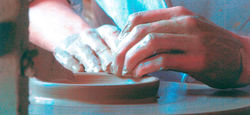
Before a pot is turned, the clay is kneaded by hand or with a special machine called “boudineuse-desaereuse” in order to remove air bubbles, and make it homogeneous. The required quantity of clay of a piece depends on its size. The block of clay is placed on the upper platform called “girelle”. First of all it is necessary to center the clay by lifting and dropping it on the “girelle” To obtain good results a potter should repeat this procedure twice and then open up the center of the clay to shape the pot.
The potter puts the piece of raw pottery on a board. Once the board is full - he slides it on the rods in the yard to dry. While several pieces continue to dry in the drying room, the others are “engobed” (covered with a mixture of clay, water and coloring oxides) inside or outside. These pieces finish drying at 80°C near the firing kiln on the second floor of the pottery during the firing. After the pottery is placed to dry, a potter checks its consistency, turns it at a certain angle to add the handles or easily “engobe” it later.